
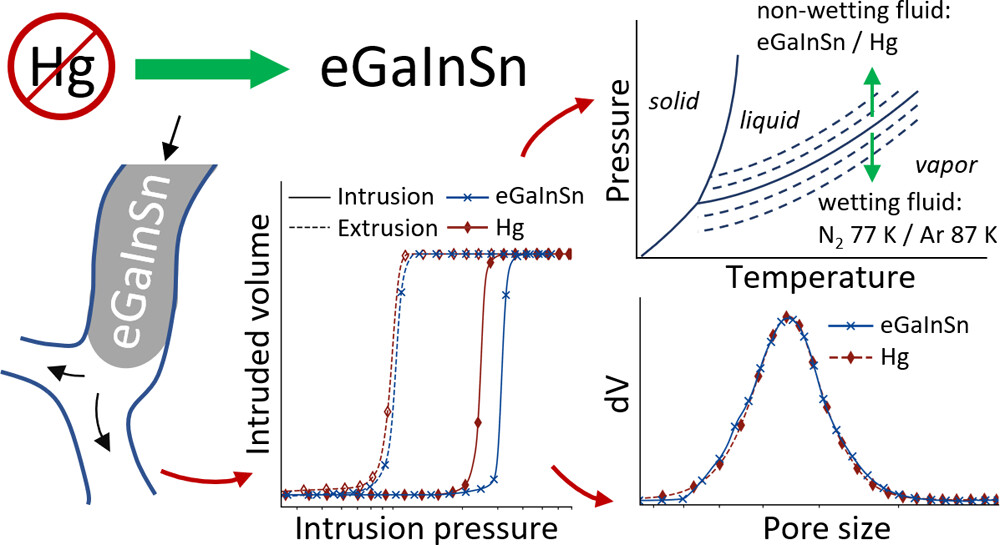
The characterization of macroporous structures is of great importance for optimizing catalysts and their supports, assessing the textural properties of adsorbents, ceramics, polymers, membranes, geological materials, and hence is key analytical technique in many industrial applications.
For this, mercury intrusion/extrusion porosimetry has been up to now considered the most useful available standard method as it can probe a wide range of pore sizes (from approximately 4 nm to > 400 µm) of various materials in a fast (< 1 h) and highly reproducible way, which, taken together, no other technique can reasonably achieve. However, health risks and environmental concerns make it highly desirable to replace mercury, and despite many advances in various techniques, so far there has been no turn-key method available.
A solution to this problem is presented by the Thommes group in the just published paper (Langmuir, June 2026, https://doi.org/10.1021/acs.langmuir.6c01577 ) entitled:
“A Nonhazardous Alternative to Mercury in Liquid Intrusion Porosimetry: Systematic Study of Intrusion/Extrusion Behavior of a Gallium-Based Liquid Metal (eGaInSn) into Meso- and Macroporous Silica, Alumina, and Carbon Materials”
(authors: Andreas Schuss, Jakob Söllner, Matthias Thommes).
The paper introduces a groundbreaking novel concept for macropore analysis. By utilizing a gallium-based liquid metal (here: eGaInSn, also known as Galinstan) as a potential replacement for mercury in liquid intrusion techniques. The paper suggests a safe and eco-friendly alternative. In fact, Galinstan is a nonhazardous, eutectic gallium alloy, which is already widely used as a replacement for mercury (e.g., thermometers).
A key advantage of this novel methodology is its compatibility: it can be used by any conventional mercury porosimeter device, requiring only minor modifications to the sample cell design and filling procedure.
The selected results presented in this just published paper, which are based on major research activities of the Thommes group during the last 5-10 years, focussing on the adsorption, phase and wetting behaviour of fluids (including liquid metals such as gallium and alloys) in porous materials, can be considered the first systematic study of the effect of confinement on the phase and wetting behavior of Galinstan (eGaInSn) in well-defined meso- and macroporous materials.
This work marks a significant step towards a replacement of toxic mercury in meso-macropore analysis with a safe and eco-friendly intrusion/extrusion methodology.
The paper is available via DOI: 10.1021/acs.langmuir.6c01577.